

Content creation used to be expensive and slow. Hiring writer, waiting for drafts, endless revision cycles. Small businesses couldn’t compete with enterprises that had massive content teams. Not anymore. AI content generators have leveled the playing field completely. A solo entrepreneur can now produce as much content as a 10-person team. The technology has matured beyond simple text generation. Modern tools understand context, maintain brand voice, and even optimize for SEO automatically.
I spent 4 weeks testing every major AI content generator. Generated over 200 pieces of content across blogs, social media, emails, and marketing copy. Compared output quality, speed, accuracy, and real-world usability. Some tools genuinely impressed me. Others were disappointing garbage that created more work than they saved.
This article shows you exactly which AI content creators actually deliver value in 2026 and which ones waste your time.
What is an AI Content Generator?
An AI content generator uses artificial intelligence to create written content automatically. Simple as that. You give it a prompt. It analyzes patterns from billions of text examples. Then generates new content based on what you asked for. Modern tools do more than basic writing. They research topics, optimize for SEO, maintain brand voice, and even suggest content strategies. The technology has matured beyond simple text generation.
Why Content Teams Are Adopting AI in 2026
The numbers tell the story clearly. Traditional content creation costs $500-2,000 per blog post with human writers. AI reduces that to essentially zero after the subscription cost. Speed matters even more than cost for most teams. Human writers take 4-6 hours per long-form article. AI generates similar content in 5-15 minutes. That’s not exaggeration. I’ve timed this repeatedly.
81% of B2B marketers now use generative AI tools. The quality has reached a point where most readers cannot tell the difference. Companies using AI report 120% increases in organic traffic within 6 months. Google’s 2025 algorithm updates confirm what many suspected. The search engine focuses on content helpfulness, not creation method. AI-generated content ranks fine if it genuinely helps users.
What Makes a Great AI Content Generator
Testing revealed clear patterns. Great tools share specific characteristics.
- Content quality and accuracy matter most. Poor AI generates generic fluff full of mistakes. Quality AI produces detailed content that actually helps readers.
- Context understanding separates good from great. Can the tool understand “write a technical blog for developers” versus “write a casual social post”? Advanced models nail these distinctions.
- Speed and reliability impact workflow efficiency. Waiting 5 minutes per generation kills momentum. The best AI content creators process requests in under 30 seconds with 99%+ uptime.
- SEO optimization determines whether content drives traffic. Built-in keyword research and optimization suggestions help content rank without additional work.
Top 6 AI Content Generators Reviewed
| Content Type | ChatGPT | Claude | Jasper AI | Copy.ai | Writesonic | Rytr |
| Blog Posts | ✓ | ✓ | ✓ | ✓ | ✓ | ✓ |
| Social Media | ✓ | ✓ | ✓ | ✓ | ✓ | ✓ |
| Email Marketing | ✓ | ✓ | ✓ | ✓ | ✓ | ✓ |
| Product Descriptions | ✓ | ✓ | ✓ | ✓ | ✓ | ✓ |
| Video Scripts | ✓ | ✓ | ✓ | ✓ | ✓ | ✓ |
| Ad Copy | ✓ | ✓ | ✓ | ✓ | ✓ | ✓ |
| Technical Documentation | ✓ | ✓ | Limited | Limited | Limited | Limited |
| Long-form Articles (3000+) | ✓ | ✓ | ✓ | ✓ | ✓ | Limited |
| SEO Meta Descriptions | Manual | Manual | ✓ | ✓ | ✓ | ✓ |
| Landing Pages | ✓ | ✓ | ✓ | ✓ | ✓ | ✓ |
1. ChatGPT

ChatGPT started the AI content revolution. Everyone knows it. But most people don’t use it effectively.
What makes it different: ChatGPT isn’t built specifically for content. It’s a general-purpose AI that happens to write exceptionally well. This versatility is both its strength and weakness.
Key Features:
- Multimodal capabilities let you upload images and documents that inform content generation.
- Memory function remembers project details across conversations without repeating context.
- Custom GPTs enable building specialized versions trained on your specific style and needs.
- Plugin ecosystem adds web browsing, data analysis, and image generation capabilities.
- Canvas mode provides a collaborative workspace for editing and refinement.
- Voice mode allows dictating content ideas and receiving spoken responses.
Best for: Content creators needing maximum flexibility and users comfortable with prompt engineering.
Real-world performance: Output quality depends heavily on prompt quality. Vague prompts produce generic content. Detailed prompts with examples generate excellent results. Processing averages 15-30 seconds for 500-word outputs.
Pros:
- Most versatile AI content generator available
- Custom GPTs enable specialized workflows
- Plugin ecosystem extends capabilities significantly
- Free tier provides substantial value
Cons:
- No built-in SEO optimization features
- Learning curve for effective prompt engineering
- Output quality varies based on prompt quality
- No native team collaboration features
2. Claude (Anthropic)

Claude has become my personal go-to for long-form content. The quality consistently impresses me.
The advantage: Claude excels at maintaining context over long conversations. You can feed it research materials and style guides. It remembers everything and applies it accurately.
Key Features:
- Extended context window handles up to 200,000 tokens of input material for comprehensive understanding.
- Artifacts feature creates formatted documents you can directly edit and export.
- Document analysis processes PDFs and research papers to inform content generation.
- Conversation memory maintains project details across multiple sessions without prompting.
- Code generation creates HTML and interactive content elements when needed.
- Citation capabilities reference source materials accurately in generated content.
Best for: Researchers creating in-depth content and writers working on long-form articles.
For more details read: Top 6 Free AI Essay Writer Tools to Try
Real-world performance: Content depth and accuracy are exceptional. Processing longer requests takes 20-40 seconds but quality justifies the wait.
Pros:
- Best context understanding of any AI content generator
- Excellent for research-heavy long-form content
- Can process and analyze uploaded documents
- Citation capabilities maintain source accuracy
Cons:
- Usage limits can be restrictive during peak times
- No built-in SEO tools
- Limited templates compared to marketing-focused tools
- Processing longer content takes more time
3. Jasper AI

Jasper AI positions itself as the enterprise solution for content marketing teams. The platform is built for scaling content production.
What makes it different: This isn’t a chatbot. It’s a complete content platform with templates, workflows, and team features. The interface is designed for marketers.
Key Features:
- Brand Voice learns your writing style from existing content and maintains consistency automatically.
- Boss Mode provides a long-form editor with AI commands for expanding and rewriting sections.
- Surfer SEO integration optimizes content for search engines during generation automatically.
- Templates cover 50+ content types from blog posts to video scripts and social media.
- Team collaboration enables multiple users working on projects with role-based permissions.
- Chrome extension generates content directly in Google Docs and WordPress.
Best for: Marketing teams creating high volumes of content and agencies managing multiple client brands.
Real-world performance: Template-based approach produces consistently good results. Processing speed is fast at 10-20 seconds. SEO integration produces content that ranks.
Pros:
- Purpose-built for marketing teams
- Brand Voice maintains consistency automatically
- Templates accelerate content creation significantly
- Surfer SEO integration optimizes during generation
Cons:
- Higher cost compared to alternatives
- Template approach can feel limiting for creative content
- Overkill for solo creators with simple needs
- Learning curve for advanced features
4. Copy.ai
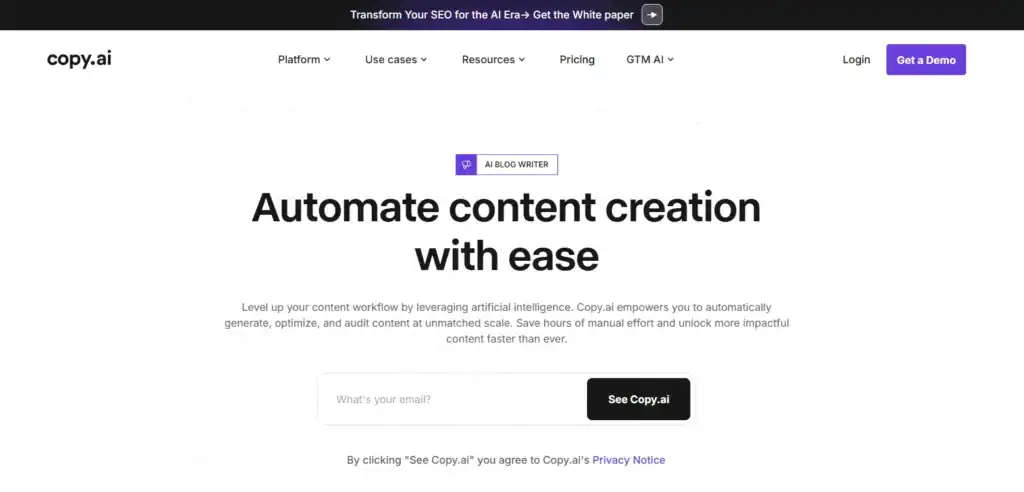
Copy.ai evolved from a simple copywriting tool into a comprehensive GTM platform. 17 million users now rely on it.
The evolution: Copy.ai realized content creation is one part of marketing workflows. They built features for research, campaign planning, and sales support.
Key Features:
- Multiple AI models use OpenAI, Anthropic, Gemini, and Perplexity depending on which performs best for each task.
- Brand Voice engine analyzes your existing content and replicates your style accurately.
- Infobase stores all brand information centrally so every team member generates consistent content.
- Workflow automation chains multiple AI operations together for complex content projects.
- Sales enablement creates personalized outreach and proposals at scale automatically.
- Free plan includes unlimited words in draft mode for testing and light use.
Best for: Startups scaling content production and sales teams needing personalized outreach.
Real-world performance: Output quality is consistently good across different content types. The multi-model approach delivers better results than single-AI tools.
Pros:
- Free plan includes unlimited draft content
- Multiple AI models ensure best performance
- Goes beyond content to support entire GTM strategy
- 17 million user base means proven reliability
Cons:
- Interface can feel overwhelming with many features
- Free plan limitations push toward paid plans
- Focus on quantity sometimes impacts quality
- Team features require higher-tier plans
5. Writesonic
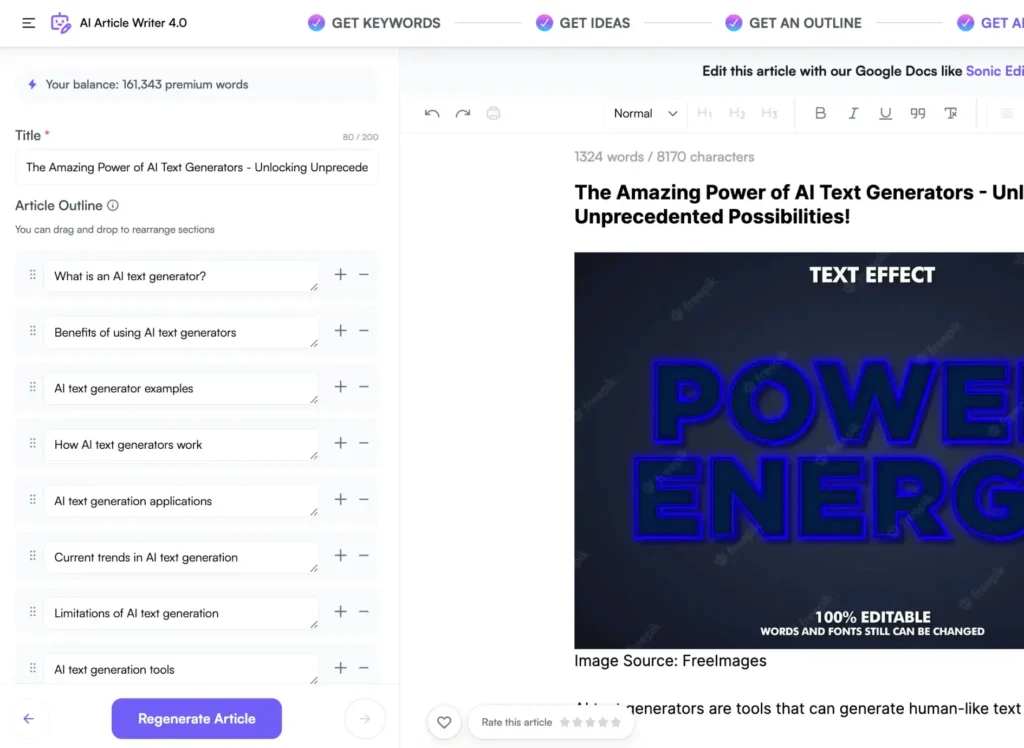
Writesonic focuses specifically on SEO-optimized content creation. Every feature is built around helping content rank.
The SEO specialization: While other tools add SEO features, Writesonic is fundamentally designed for search-first content. Every feature optimizes for ranking.
Key Features:
- Article Writer generates complete articles optimized for specific keywords with competitor analysis built in.
- Sonic Mode provides real-time web access for current information and statistics.
- Photosonic creates AI-generated images to accompany articles automatically.
- Chatsonic is a ChatGPT alternative with web browsing and multimodal capabilities.
- Instant article generation creates 1,500-3,000 word posts in under 5 minutes.
- Bulk article generation processes up to 100 articles simultaneously for scaling.
Best for: SEO agencies and content marketers focused on organic traffic.
Real-world performance: SEO optimization is genuinely effective. Articles rank within 2-3 months. Processing is extremely fast. Quality sometimes requires editing.
Pros:
- Exceptional SEO optimization capabilities
- Extremely fast content generation
- Real-time web access provides current information
- Bulk article generation scales production
Cons:
- Output sometimes requires significant editing
- Brand voice consistency varies across articles
- Free tier is very limited
- Interface feels dated compared to newer competitors
6. Rytr

Rytr is the best budget option without sacrificing quality. The free plan is genuinely useful.
The budget approach: Rytr strips away enterprise features and focuses purely on generating good content quickly. No fancy dashboards. Just straightforward AI writing.
Key Features:
- 40+ use cases cover every common content type from blog posts to product descriptions.
- 30+ languages enable content creation for international audiences easily.
- 20+ tone options let you adjust writing style from formal to casual.
- Built-in plagiarism checker ensures content originality automatically.
- SEO analyzer provides basic optimization recommendations for better ranking.
- Chrome extension generates content in any text field across the web.
Best for: Solo creators on limited budgets and small businesses testing AI content generation.
Real-world performance: Content quality is surprisingly good given the low cost. Output sometimes feels formulaic but editing fixes this. Processing is fast.
Pros:
- Most affordable option without sacrificing quality
- Free tier is genuinely useful
- Simple interface requires zero learning curve
- Chrome extension enables generation anywhere
Cons:
- Lacks advanced features of enterprise tools
- Output can feel formulaic
- Limited SEO optimization capabilities
- No team collaboration features
Feature Comparison Table
| Feature | ChatGPT | Claude | Jasper AI | Copy.ai | Writesonic | Rytr |
| Best For | Versatility | Long-form | Marketing | Sales+Marketing | SEO | Budget |
| Output Quality | Excellent | Excellent | Very Good | Very Good | Good | Good |
| Processing Speed | Fast | Medium | Fast | Fast | Very Fast | Fast |
| SEO Features | Basic | Basic | Advanced | Moderate | Advanced | Basic |
| Team Features | No | No | Yes | Yes | Yes | No |
| Brand Voice | Manual | Manual | Automatic | Automatic | Manual | Manual |
| Free Plan | Limited | Limited | Trial | Yes | Limited | Yes |
| Templates | No | No | 50+ | 90+ | 80+ | 40+ |
Use Case Recommendation Matrix
| Your Primary Need | Best Tool | Runner-Up | Why |
| SEO-focused blog content | Writesonic | Jasper AI | Built-in competitor analysis and keyword optimization |
| Long research articles | Claude | ChatGPT | Handles massive context and maintains accuracy |
| Marketing team collaboration | Jasper AI | Copy.ai | Team features and brand voice consistency |
| Budget-friendly option | Rytr | Copy.ai Free | Best value without sacrificing core quality |
| Sales outreach emails | Copy.ai | Jasper AI | Specialized sales enablement features |
| Versatile general writing | ChatGPT | Claude | Handles any content type effectively |
| Bulk content production | Writesonic | Copy.ai | Fast processing and batch capabilities |
| Technical documentation | Claude | ChatGPT | Superior context handling for complex topics |
How to Choose the Right Tool
Picking the perfect AI content creator depends on three factors: your use case, your budget, and your technical comfort.
- For versatile general content: ChatGPT or Claude provide maximum flexibility. You can create anything from technical documentation to creative stories.
- For SEO-focused content: Writesonic optimizes specifically for search rankings. Built-in competitor analysis helps content rank faster.
- For marketing teams: Jasper AI or Copy.ai provide templates and workflows that scale content production efficiently.
- For budget-conscious creators: Rytr delivers solid quality at a fraction of competitor costs. The free tier lets you test thoroughly.
Common Mistakes to Avoid
Using vague prompts guarantees generic output. “Write a blog post about marketing” produces useless fluff. Specific descriptions produce useful content.
- Accepting first drafts without editing creates mediocre content. AI generates good starting points, not finished products. Plan to spend 30-50% of saved time editing.
- Ignoring brand voice makes content feel generic. AI defaults to neutral tones. Your brand likely has personality. Provide examples of your writing style.
- Forgetting to fact-check leads to publishing inaccuracies. AI occasionally makes up statistics. Always verify factual claims before publishing.
Tips for Better Results
- Start with detailed prompts that include context, audience, and tone. More information upfront means less editing later.
- Generate multiple variations before selecting the best one. Creating 3-4 versions takes 2 minutes but dramatically improves quality.
- Use AI for research and outlining first. Review and refine the outline before generating full content.
- Provide feedback and iterate. Tell the AI specifically what to change rather than starting over.
Final Thoughts
AI content generators have matured from experimental toys to essential business tools. The right tool depends entirely on your specific needs. ChatGPT works beautifully for versatile content. Writesonic dominates SEO-focused content. Jasper serves marketing teams. Rytr handles budget-conscious creators.
Start with free tiers to test workflows before committing. Most tools offer enough free generation to evaluate fit. Upgrade only when limitations actually slow your work. The best AI content generator is the one you’ll actually use consistently to improve your output.
Frequently Asked Questions
What is the best free AI content generator?
ChatGPT’s free tier provides the most capabilities. Rytr offers the most generous free plan with 10,000 characters monthly. Copy.ai’s free plan includes unlimited words in draft mode. Your choice depends on whether you prioritize versatility or volume.
Can Google detect AI generated content?
Google can detect AI content but doesn’t penalize it. Google’s official position is that content quality matters, not creation method. Focus on creating helpful content rather than hiding AI usage.
How do I make AI content sound more human?
Provide detailed prompts including your desired tone. Edit generated content to add personality and specific examples. Use tools with brand voice features. Read content aloud and revise anything that sounds robotic.
Are AI content generators worth the cost?
For most businesses, yes. The cost savings compared to hiring writers is 80-90%. The speed increase is 10-20x faster. Free tiers let you test before committing.
What’s the difference between ChatGPT and specialized generators?
ChatGPT is general-purpose AI that writes well. Specialized generators like Jasper are built specifically for content marketing with templates and SEO tools. ChatGPT offers more flexibility. Specialized tools offer better features for specific needs.