These tools work surprisingly well and genuinely save people massive amounts of time and money, which is why adoption has been so fast across different industries.
What These Things Actually Do
You know all those annoying parts of editing photos?
- Cutting out backgrounds.
- Fixing wonky lighting.
- Removing random stuff you don’t want.
- Making fuzzy images sharp.
- Color correction.
All those boring things used to mean opening Photoshop, watching a million YouTube tutorials, and clicking endlessly through menus. It was completely senseless.
AI editors just handle it for you. Add the picture, explain what is wrong, bang, bang, boom. The program analyses your image and determines how to correct it.
What shocked me was the manner in which these had improved in recent times. Like two years ago? AI edits looked super fake. Now, the majority of individuals cannot tell the difference. Even experts occasionally lose their heads and say Wait, that is AI?
Moreover, they do not simply make work faster. They do things that are not even practical. Do you have to have 100 product shots with various backgrounds? That was thousands of dollars. It could be 20 dollars and one hour now.
Why Everyone’s Using This Stuff Now
This change occurred much quicker than anybody imagined. Professional editing would require months of learning Photoshop. Then there were apps such as VSCO that simplified simple things. Now, AI has simply eliminated all of those barriers.
It is actually small businesses that are on the move. They require good photographs, yet they cannot afford professional photographers. AI allows them to create good stuff on their own.
Social media helped it explode, as well. You are on Instagram and TikTok, and you always need content. No one has time to spend hours on each and every image. Artificial intelligence will allow you to literally stay on top of things without sacrificing quality.
This is all the rage with e-commerce people. Other firms experienced 87 per cent increases in revenue when they changed to AI to take product photographs. That is not just a small change; it is literally changing the way they conduct business.
Top 10 AI Image Editors You Can Use Right Now
1. Adobe Photoshop with Firefly AI

Best For: If you need professional-level stuff
Photoshop experience, however, was basically the 30 years of experience that Adobe incorporated into what can be described as AI capabilities directly into it, and makes it likely one of the most powerful image editors you can currently have your hands on. The Generative Fill option is quite frankly mad as you simply type what you want added or taken away of your image, and it does it.
Do you desire mountains in the background? Type it in, and they appear. Somebody photobombing your picture? Photoshop fills the space in a natural way by painting over it, and the results are much better than you would expect.
Another option, called Generative Expand, is what makes your images larger than their natural borders so in case you have taken an image in portrait mode and then you unexpectedly need it in landscape format, the AI will simply generate more on the image, which perfectly resembles your original picture.
One-Click fixes on the most popular filters, such as smoothing skin, blurring backgrounds, color cast, replacing the sky, etc. are offered by Neural Filters. The filters are based on machine learning; therefore, the results in fact appear to be legitimate and professional with minimal effort on your part.
Object Selection AI It automatically grabs certain objects, and thu,s you can just click on a person and Photoshop picks them out at the right spot, even the hard-to-define bits like hair that would have once taken hours to get perfect manually. They all work together with Creative Cloud as well, so you can begin on your computer, continue on your iPad, and finish anywhere you like since it all works together automatically.
Pricing: $54.99/month for Photography plan, $59.99/month single app.
2. Canva AI Photo Editor
Best For: Social media people
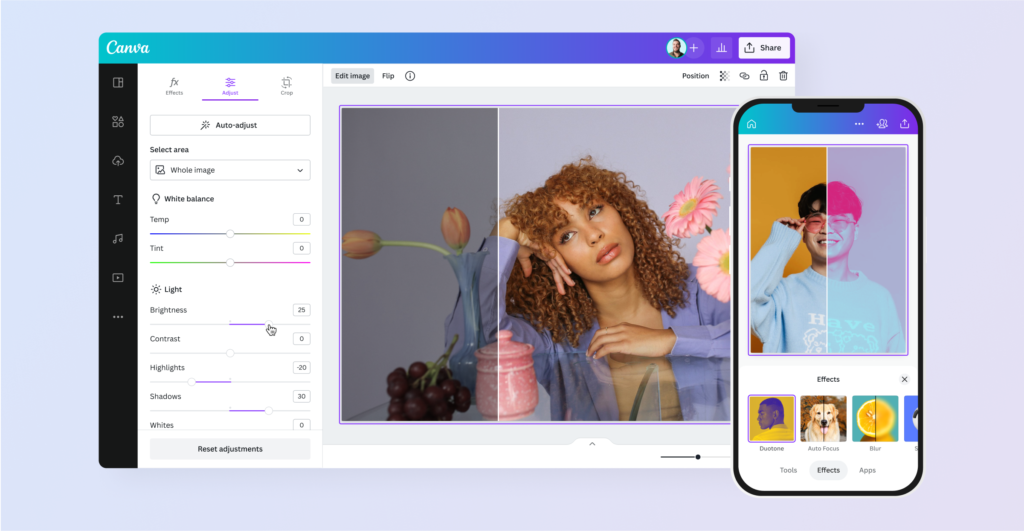
Canva earned its fame by rendering design accessible to all, and their photo editor essentially accomplishes the same to image editing which is quite convenient to ask me.
Magic Edit operates on text prompts in which you simply brush over your photo, specify what you wish to change, and watch it do it before your eyes. It allows you to change colors, change backgrounds, add or delete whatever you want and the interface is so easy to understand that just about anyone can learn how to use it without directions.
Background Remover is simply what the name implies, with a single click, and in the event that you operate any sort of e-commerce business, then this feature alone is likely to be worth the subscription fee. The Magic Eraser removes the unwanted features, such as that creepy tourist who just walked in your vacation photo; you just click, and they are gone.
Photo enhancement uses an algorithm to automatically fix lighting, color, and clarity, and it generally does wonders with one click without any manual intervention. Design templates also fit right into your photo editing process, meaning you can edit your photo and instantly insert a social media template or a marketing template without the need to switch between apps.
Pricing: Free version exists. Pro’s $12.99/month yearly or $14.99/month monthly.
3. Pixlr AI Editor
Best For: If you’re broke but need good tools
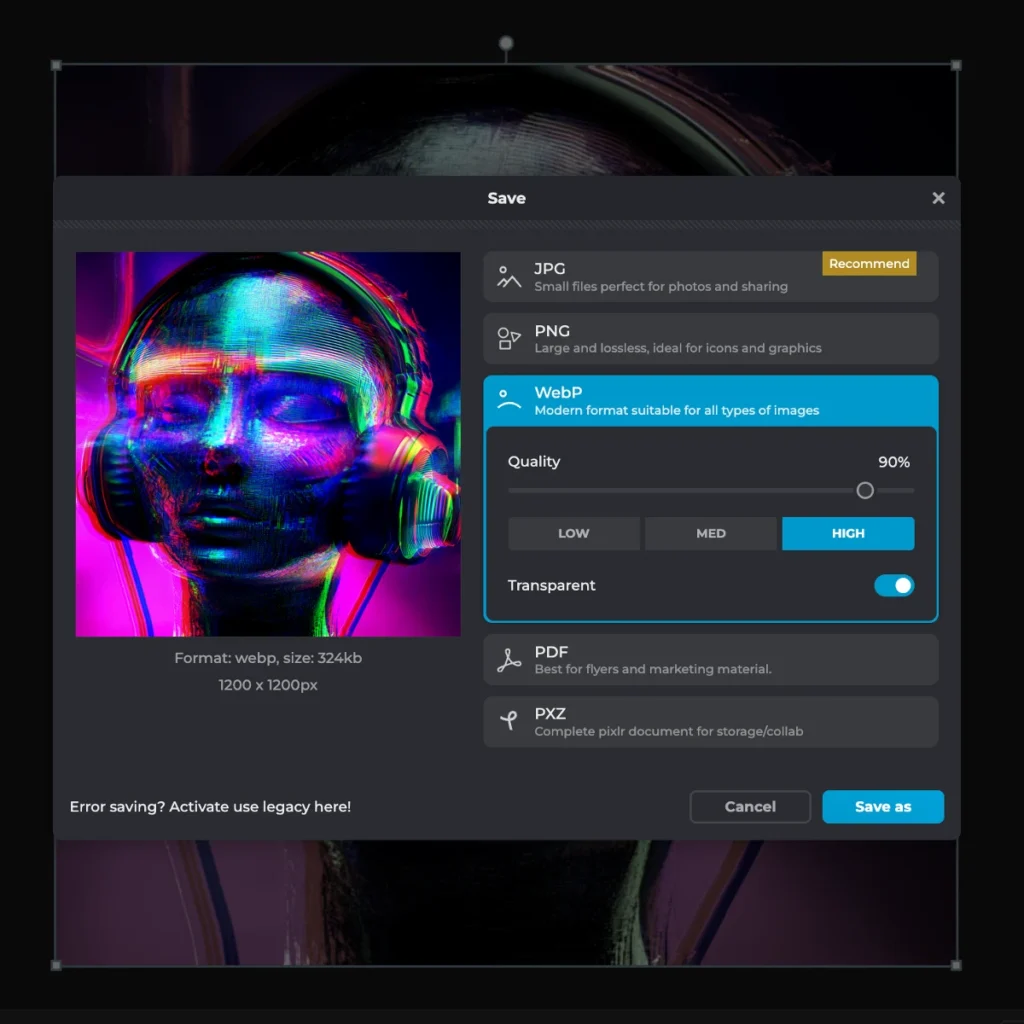
Pixlr provides you with the rightful professional AI tools absolutely free, which is rather impressive when put in perspective of what most of the other platforms cost you to do the same thing. Background removal is done immediately upon uploading an image and the most interesting thing is that the free exports do not carry any watermarks and this is in itself unusual with free editing software.
Generative Fill will also add or remove things by typing prompts, meaning you can modify colors on shirts, erase telephone poles or do whatever you need to do without spending a penny.
Image upscaling ensures that low resolutions are increased in size but not making them all blurry and pixelated. This comes in handy when you require various sizes of images on social media sites. The entire thing can be used directly through your browser, without downloads or installations, and the simplest features of it do not require creating an account which makes it ultra available.
Pricing: Free has most stuff. Plus is $1.99/month, Premium $7.99/month.
4. Luminar Neo
Best For: Photographers who want desktop software
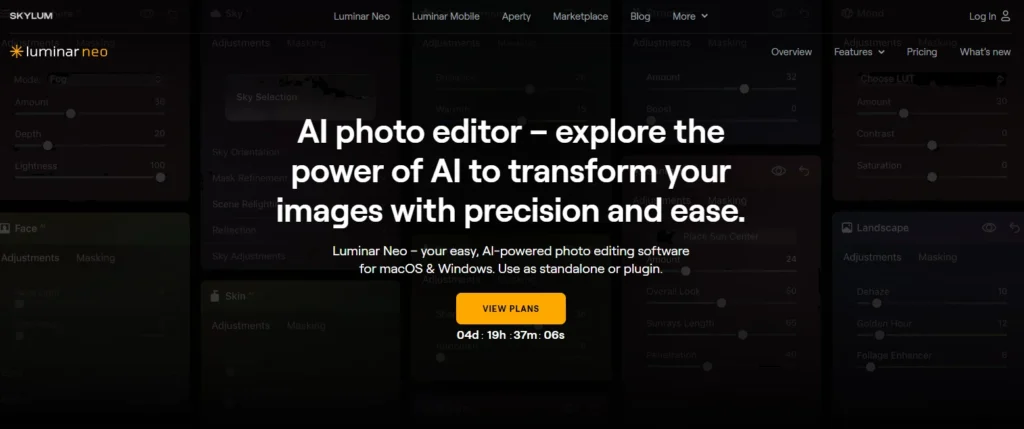
Luminar Neo specializes in creative AI, with the selection aimed at photographers who actually know what they are doing and have experience related to photo editing processes. Sky AI allows you to replace dull grey skies with violent sunsets or starry nights, and what is even better is that it automatically changes the whole picture to match the light of the new sky to make everything look natural.
Portrait AI cleans up faces and keeps them natural that way so that your subjects are not left to look like they are walking out of a magazine with fake and over-airbrushed faces. Enhance AI is a single slider that enhances images through a combination of simple to intense image enhancement, making it an enhancement tool that depends on what the photo requires.
GenErase removes unwanted objects in a clean manner, and you just paint over it and the background naturally fills in, which is perfect to eliminate distractions. It is even available as a perpetual license purchase rather than a subscription forever, and that is some actual relief and is attractive to photographers who loath constant monthly payments.
Pricing: $11.95/month subscription or $119+ one-time payment.
5. Photoroom
Best For: E-commerce product stuff
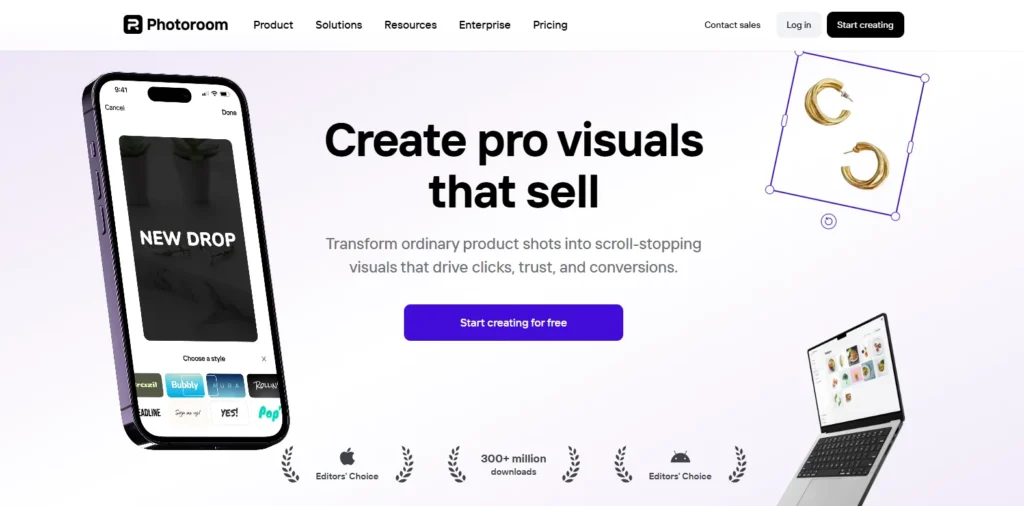
Photoroom has based its whole foundation on allowing product photography to be simple and professional, and it genuinely accomplishes this exceptionally well in comparison to more general-purpose editors. Background removal is ideal when working with product photos, and it even does the same with the annoying and difficult glass and see-through items that other programs are not fond of.
Background replacement includes templates you have professionally designed so that you can use the same in designing your products throughout the range of your products without actually having to have a real studio.
This tool works best when you are batch editing since you can do more than one image at the same time, meaning that you can upload 50 product photos and make the same edits on each image and have it done in a few minutes, which saves enormous amounts of time.
Smart resizing will automatically fit your images to other platforms (Instagram, Amazon, Shopify, etc.), and every version will be of high quality with the correct dimensions, so you do not need to resize all of your images manually.
Pricing: Free but adds a watermark. Pros $9.99/month yearly or $19/month monthly.
6. Fotor AI Image Editor
Best For: Want everything in one place
Fotor offers a combination of photo editing, AI technology, and design features in a single platform that is good when you do not want to use several applications to accomplish various tasks.
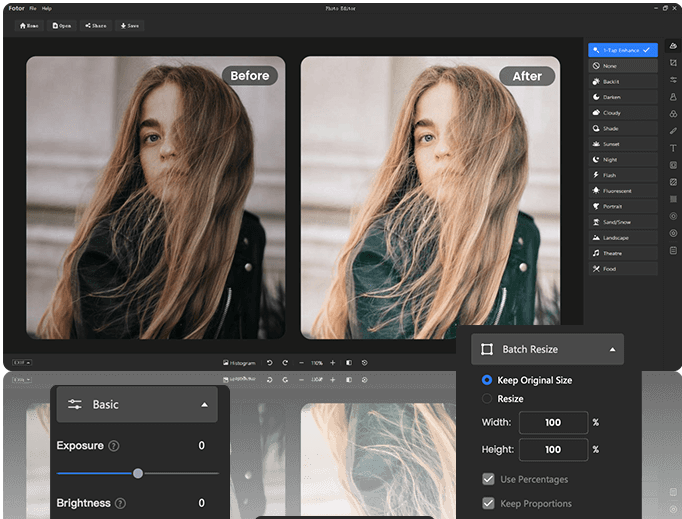
One-click enhancement is a drastic way of enhancing the image automatically, by scanning the picture and changing its aspects such as lighting, coloring, and sharpness to make everything appear better, and the outcome is usually surprisingly good, given how uncomplicated the process is.
AI background remover isolates your subjects cleanly regardless of whether you are dealing with portraits, products, or random objects, and even deals with the challenging edge issues, such as hair and fur, quite well. Instead of default AI-style filters, Photo effects and filters are styled directly on your image, and therefore, the system knows what is in your photo and automatically applies the appropriate effects.
Design templates are a part of the photo editing process i.e. once you finish your photo editing, you can drop it onto a social media template or marketing materials or any other design project that you are working on without having to go over to a different tool.
Pricing: Free version is basic. Pro’s $8.99/month or $39.99/year.
7. Piktochart AI Image Editor
Best For: Marketing and business visuals
Piktochart actually began as an infographic creator, but at some point incorporated a strong AI image editing feature that is particularly effective at business and marketing applications.
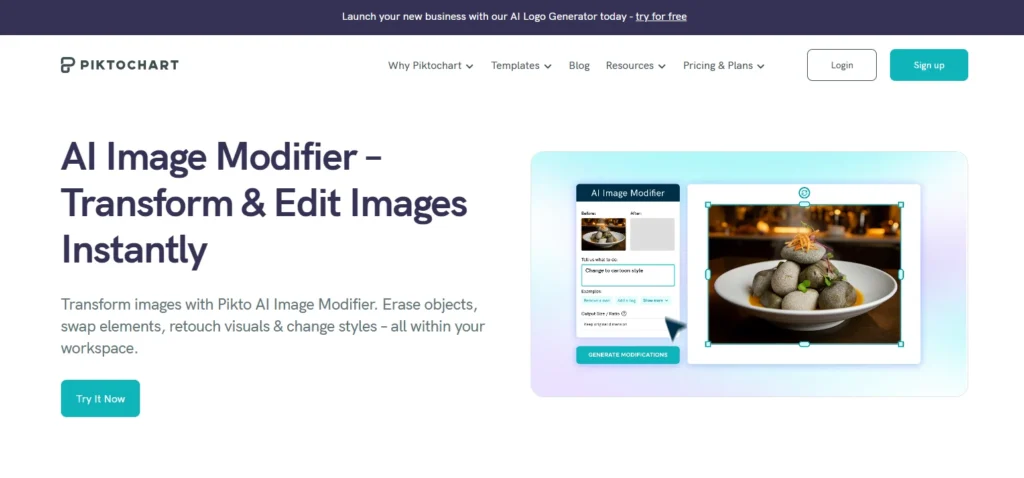
Image Modifier transforms photos using natural text commands, meaning you can literally tell it to change the sky color to orange or add a cup of coffee to the table, and the AI knows what you would like to do and does it.
Background remover is fast and precise enough to satisfy the majority of business purposes, which, in fact, can be very helpful when you need to produce marketing materials that require clean product shots or isolated individuals without a background.
This tool is most likely to be used with design templates, as you can work with your pictures and then instantly apply them to infographics, presentations, social media posts, or reports without necessarily exporting and importing data between applications.
The complete working process occurs in a single location, saving time and maintaining everything in order, even when marketing teams are handling many projects at the same time.
Pricing: Free but limited AI. Pro’s $12.99/month.
8. Topaz Photo AI
Best For: Quality matters more than anything
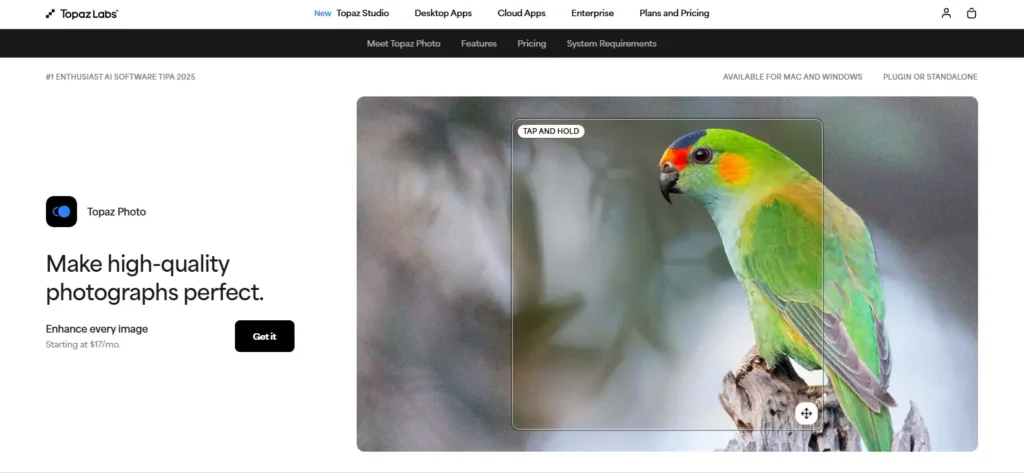
Topaz Photo AI specializes in making images actually look better through AI-powered enhancement rather than focusing on creative effects or artistic filters. AI sharpening improves clarity and detail without that over-sharpened artificial look that makes photos seem fake or heavily processed.
Noise reduction removes grain and noise from images while keeping important details intact, which is really valuable when you shoot photos in low light conditions that naturally come out grainy. AI upscaling increases resolution dramatically and can take a 1000-pixel image all the way up to 4000 pixels while maintaining sharpness and detail, which honestly seems pretty crazy when you see it work on an actual image.
Face recovery specifically enhances portraits by recognizing faces and applying appropriate enhancements to skin, eyes, and facial features to make old family photos or low-quality portraits look amazingly better. The focus on quality improvement makes this tool perfect for photographers who care more about technical excellence than creative manipulation.
Pricing: $199 one-time payment. Free trial available.
9. Remove.bg
Best For: Background removal and that’s it
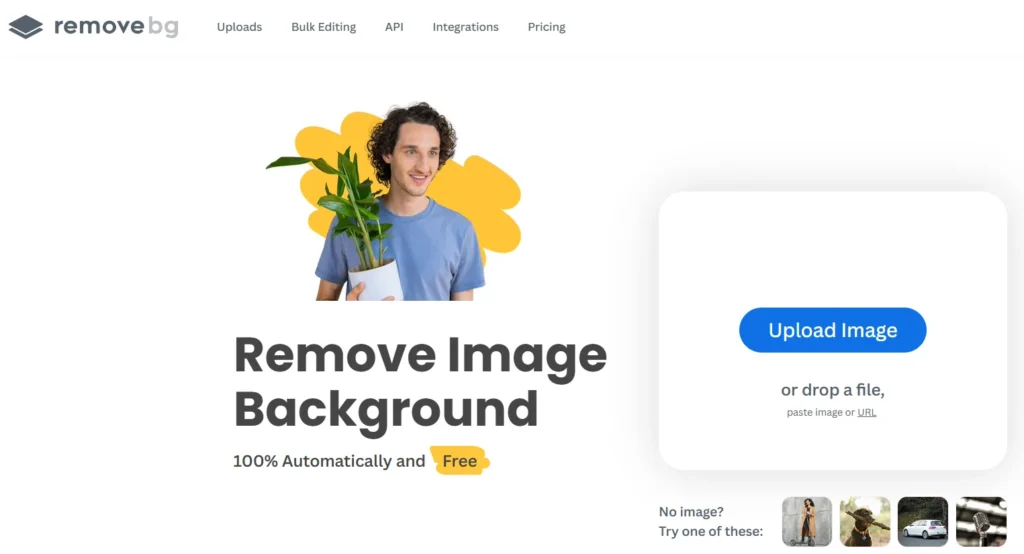
Remove.bg does literally one thing, which is removing backgrounds from images, but it honestly does this one thing better than pretty much anyone else in the market. Automatic background removal happens in about 5 seconds after you upload an image, and the process is ridiculously fast while still being surprisingly accurate even for difficult subjects with complex edges.
The platform provides an API for developers who are building applications or workflows that need background removal capabilities, and many e-commerce platforms actually integrate this service directly into their systems. Bulk processing is available for businesses dealing with high volumes of images, so you can upload entire folders and process hundreds or thousands of product photos all at once.
The quality of edge detection is really impressive and handles challenging subjects like hair, fur, glass, and transparent objects accurately in ways that rival manual Photoshop work done by experienced professionals.
Pricing: Free for low-res. Starts at $9/month for subscriptions.
10. Cleanup.pictures
Best For: Getting rid of unwanted stuff
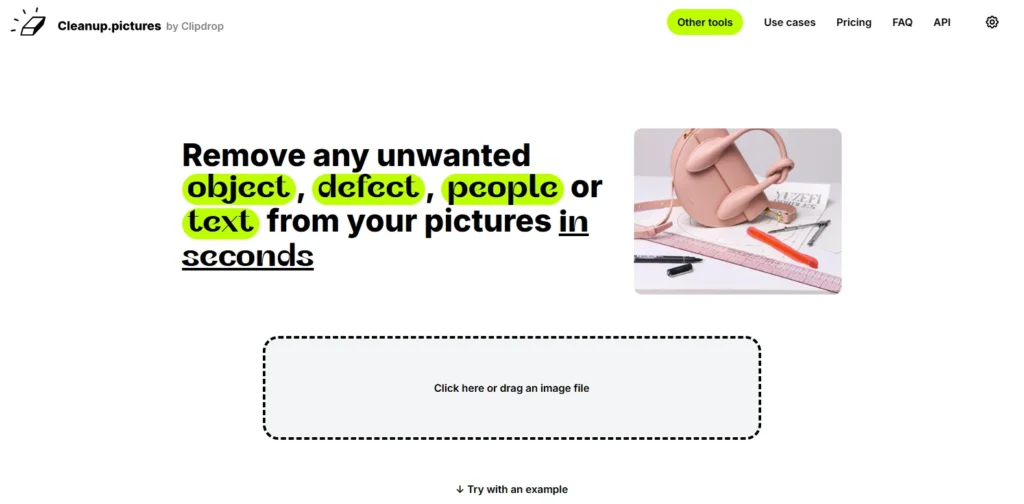
Cleanup.pictures specializes in removing unwanted elements from your photos and basically works like a digital eraser for photobombs and other distractions you want gone. Object removal works through simple brushing where you just paint over anything you want removed like people, objects, watermarks, text, or blemishes, and the AI removes them cleanly while filling the space with background that matches naturally.
No signup is required for basic use which makes it super convenient because you just visit the website, upload your image, remove whatever you need gone, and download the result without creating any accounts or going through registration processes. The tool is free with reasonable limits on resolution and monthly usage, which is completely sufficient for casual users who only need to remove stuff from photos occasionally.
Privacy-focused processing means your images aren’t stored permanently on their servers; they get processed and then deleted which matters if you’re editing sensitive or personal photos.
Pricing: Free version available. Pro’s $5/month for unlimited high-res.
Which One Should You Actually Use
Look, picking the right tool really depends on what you’re actually trying to accomplish with your image editing. If you’re a professional photographer who needs serious control and the highest quality possible, you should go with either Adobe Photoshop or Luminar Neo because these tools provide the advanced features and precision that professional work demands. If you’re selling stuff online and need to process lots of product photos, Photoroom or Remove.bg are specifically made for product photography and will save you massive amounts of time. Social media people should probably use Canva because it combines editing and design capabilities together in one platform, so you can edit images and immediately drop them into social templates without switching apps. If you have no money to spend but still need professional features, Pixlr is legitimately free and actually good without adding watermarks to your exports. When you just need backgrounds removed quickly and nothing else matters, Remove.bg does this one specific thing better than literally everyone else in the market. If your main problem is that your image quality sucks and you need to make fuzzy low-resolution photos look sharp and professional, Topaz Photo AI makes stuff sharper and enhances quality better than any other tool available right now.
How to Get Better Results
Getting better results from AI editors comes down to a few simple principles that actually make a real difference. You need to start with decent photos because AI makes images better but absolutely cannot fix total garbage, so make sure you have decent lighting and proper focus from the very beginning. Being specific with your instructions helps a ton, so instead of just saying “make it better” you should say exactly what you want like “brighten the subject, soften the background, add warm tones” which works way better than vague requests. Using high-resolution images whenever you have them available is important because AI works significantly better when it has more pixels to analyze and manipulate. Remember that AI typically gets you about 80 to 90 percent of the way there, so you should spend a couple minutes on final touches and small adjustments to really make the image pop. Always save your original unedited versions because you’ll probably need them later if you want to try different edits or if something goes wrong with your current version.
Don’t Do These Things
There are some predictable mistakes people make when they start using AI image editors, and you should avoid falling into these traps. Stop over-processing your images just because you can pile on tons of effects and adjustments, because less is usually better looking and more professional than going overboard with every feature available. Think about context because AI doesn’t understand situations and meaning the way actual people do, so you need to make sure everything in your image makes sense together and looks natural. Chill out about expecting instant perfection because sometimes getting exactly what you want takes a few tries, and that’s totally normal so don’t get frustrated. Use the right tools for each specific job because background removal tools aren’t great for creative manipulation and creative tools aren’t ideal for technical tasks, so you should match the tool to what you’re actually trying to accomplish. Always zoom in and check your final result carefully because AI sometimes creates small weird artifacts or problems that aren’t obvious when you’re viewing the whole image, so check all the details before you consider it done and share it anywhere.
What’s Actually Changing in the Industry
The AI image editing space evolves incredibly fast right now, and there are several clear trends shaping where things are heading in the next couple years. Mobile editors are getting way more powerful, and the gap between desktop and mobile capabilities is closing faster than most people expected. Mobile AI editors can now handle complex tasks that absolutely required desktop software just a year ago, which matters a lot because most people do pretty much everything on their phones these days anyway. Real-time processing is becoming the standard instead of being some premium feature, because AI edits that used to take several minutes now happen basically instantly. As computing power keeps increasing, even the most complex edits will process in real-time so you can see results immediately while you work instead of waiting around.
AI editing capabilities are being built directly into existing platforms instead of staying as separate tools. Instagram, TikTok and other social apps already include AI editing features in their own editors. This integration will keep accelerating. Very soon, AI options will feel like standard parts of every photo application. Specialized tools are emerging too. Instead of general‑purpose editors that do everything just “okay,” we’re seeing focused tools that do one job extremely well. Background removal, image enhancement and object removal each have their own dedicated tools now. They are optimized for that single task and often work much better than all‑in‑one solutions. Ethical concerns around authenticity are finally being taken seriously as AI editing becomes more powerful and realistic. Questions about image manipulation and what’s real versus fake matter more than ever. Many tools are starting to add metadata and digital watermarks to show when an image has been AI edited. This trend will speed up as public concern about fake images and misinformation keeps growing.
Bottom Line
Photo editing used to mean expensive software and months of learning. Now literally anyone can make pro-looking images on their phone. These AI tools aren’t perfect but they work damn well for what most people actually need.
Tech keeps getting better too. AI’s getting smarter, results look more real, everything’s faster.
Just grab a tool that fits what you need and your budget. Most have free versions or trials anyway. Play around with it. Figure out what it’s good at. Your first stuff won’t be perfect, who cares? You’ll get way better fast.
Pretty much all the old barriers are gone. Anyone can make professional-looking images now. Just pick something and start making the visuals you need.