




Twilio is one of the platforms that helped define Communications Platform as a Service (CPaaS). Its APIs give developers a relatively straightforward way to add SMS, MMS, voice, verification, WhatsApp, and other communications capabilities to applications without building telecom infrastructure themselves.
That flexibility remains valuable.
But in 2026, choosing an SMS provider isn't simply about finding an API that can execute a POST request and deliver a text message. Businesses evaluating alternatives to Twilio now have to account for A2P 10DLC registration, carrier surcharges, throughput, sender types, message segmentation, routing, deliverability, opt-out handling, CRM integration, engineering overhead, and support.
Once those factors enter the equation, Twilio is no longer the automatic choice for every organization.
Some businesses need a lower-cost programmable SMS API. Others want direct telecom infrastructure. Enterprise teams may prioritize international carrier coverage and omnichannel messaging. Sales and marketing teams often need something entirely different: reliable business SMS that integrates with their existing CRM without requiring engineering involvement every time a workflow changes. Others are searching for a good twilio chat alternative for two-way, app-based conversations rather than one-way SMS blasts.
That's why we compared the leading Twilio alternatives for 2026 based on how they perform in real-world messaging environments - not simply how many features appear on their product pages. If you're weighing SMS and communications tooling more broadly, our directory of business management tools and marketing & advertising tools is a useful place to compare adjacent categories once you've narrowed down your messaging stack.
The Best Twilio Alternatives in 2026
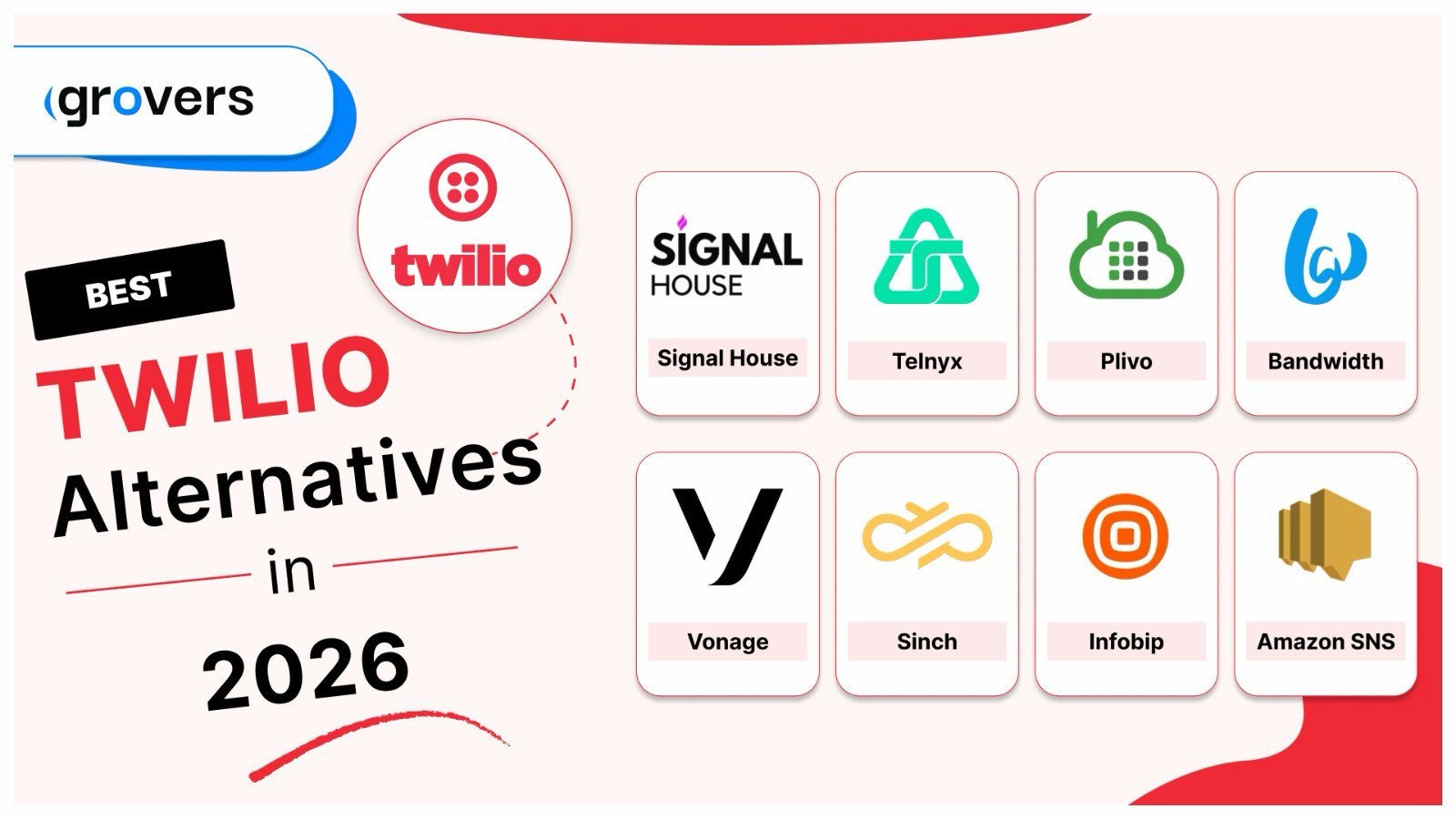
Our shortlist of the best twilio alternatives:
1. Signal House - Best overall for A2P SMS, CRM integration and operational simplicity
2. Telnyx - Best for developers wanting greater telecom and API control
3. Plivo - Best cost-focused alternative for programmable SMS
4. Bandwidth - Best for enterprise-grade communications infrastructure
5. Sinch - Best for international and omnichannel messaging
6. Vonage - Best broad CPaaS alternative to Twilio
7. Infobip - Best for enterprise customer engagement across channels
8. Amazon SNS - Best for transactional SMS inside AWS environments
There is an important qualification to that ranking.
Signal House isn't trying to replace every component of Twilio's communications ecosystem. Telnyx isn't primarily trying to become a marketer's campaign dashboard. Amazon SNS isn't trying to become a full CPaaS.
They solve different problems.
So instead of asking only, "What is the best alternative to Twilio?", a better question is:
"Which Twilio alternative best matches the way our organization actually sends and manages messages?"
Best Twilio Alternatives 2026: SMS API Technical Comparison
| Platform | Best for | SMS API | A2P/business SMS | CRM-friendly | Developer dependency | Pricing approach |
|---|---|---|---|---|---|---|
| Signal House | Business SMS + CRM workflows | Yes | Strong | Strong | Low–Medium | Business-focused |
| Telnyx | Programmable telecom infrastructure | Yes | Strong | Moderate | High | Usage-based |
| Plivo | Cost-focused SMS API | Yes | Strong | Moderate | High | Usage-based |
| Bandwidth | Enterprise telecom infrastructure | Yes | Strong | Moderate | High | Usage/enterprise |
| Sinch | Global omnichannel messaging | Yes | Strong | Strong | Medium–High | Usage/enterprise |
| Vonage | Broad CPaaS requirements | Yes | Strong | Strong | Medium–High | Usage-based |
| Infobip | Enterprise engagement | Yes | Strong | Strong | Medium | Enterprise/usage |
| Amazon SNS | AWS transactional messaging | Yes | Moderate | Limited | High | Usage-based |
Quick recommendation
If your priority is business SMS, A2P messaging and CRM-connected workflows, start with Signal House.
If you want low-level API and telecom control, evaluate Telnyx.
If you're primarily optimizing programmable SMS cost, Plivo belongs on the shortlist.
If you're building communications infrastructure at enterprise scale, look closely at Bandwidth.
And if your requirements extend well beyond SMS into WhatsApp, RCS, voice, email and international customer engagement, Sinch or Infobip may be a better architectural fit. (If email is a channel you're actively building out, our email marketing tools guide and email outreach deals are worth a look alongside your SMS decision.)
Why Look for a Twilio Alternative?
Twilio isn't a bad product that needs replacing.
In fact, for some architectures, replacing it would create more problems than it solves.
The issue is that Twilio is a broad developer platform, while many organizations have a much narrower operational requirement.
Consider a CRM-driven sales organization.
Its requirements might be:
- Send and receive SMS from its CRM
- Register compliant A2P campaigns
- Keep conversations attached to customer records
- Automate messages from CRM triggers - often via a connector like Zapier
- Handle STOP/opt-out events correctly
- Monitor delivery, ideally with a marketing analytics tool
- Let sales representatives operate the system
- Escalate deliverability problems without involving multiple vendors
Technically, Twilio can support that.
But "can support it" and "provides the most efficient operating model for it" are two different questions.
That's where specialized alternatives become interesting and it's exactly the gap that pushes teams to search for the best twilio alternatives for CRM SMS integration rather than staying on a general-purpose API.
1. SMS pricing gets more complicated at scale
The advertised API rate is only one component of SMS cost.
Your effective cost can include:
API/platform fee + carrier surcharge + sender/number cost + A2P registration + message segmentation + support + engineering overhead
This distinction matters.
A 160-character GSM-7 SMS generally fits into one segment. Longer messages can be broken into multiple billable segments, while Unicode characters can reduce the number of characters available per segment.
So comparing providers using a headline "price per SMS" without understanding traffic composition can produce a misleading cost model — which is exactly why a simple Twilio SMS pricing lookup rarely tells the whole story.
2. A2P compliance is now part of the infrastructure
For U.S. application-to-person traffic over 10-digit long-code numbers, A2P 10DLC registration is no longer an optional operational detail.
Businesses need to think about brand and campaign registration, consent, opt-out handling, use-case classification and carrier requirements.
The best provider isn't necessarily the one with the most flexible API.
It may be the provider that removes the most operational friction between registration and production traffic.
3. Developer time has a real cost
API-first platforms are attractive because developers can build almost anything.
But someone still has to build it.
If your engineering team needs to create campaign interfaces, CRM synchronization, retry logic, webhook processing, reporting, consent management and internal tooling, the effective cost of the messaging stack can be much higher than its SMS rate suggests.
This is particularly important when comparing Twilio against more business-oriented alternatives, and it's a big reason teams start searching for the best twilio alternatives for CRMs looking to integrate SMS instead of building that layer themselves.
4. Support matters when SMS becomes revenue infrastructure
If SMS is used for authentication, lead response, appointment reminders, customer notifications or revenue-generating campaigns, a routing or deliverability issue isn't merely a technical inconvenience.
It becomes a business problem.
Response time and access to knowledgeable support should therefore be treated as infrastructure requirements rather than optional extras.
1. Signal House - Best Overall Twilio Alternative
Best for: SaaS companies, agencies, sales teams, marketing organizations and businesses that need reliable A2P SMS without turning messaging into a permanent engineering project.
Signal House takes a different approach from most Twilio competitors.
Rather than competing primarily on the size of its API catalog, it focuses on the operational layer around business messaging: SMS and MMS, A2P 10DLC, messaging APIs, CRM integration, campaign execution and the infrastructure required to keep business messaging manageable.
That distinction is important.
A technically capable SMS API solves the transport problem:
Application → API → carrier network → recipient
But most businesses have a larger workflow:
CRM / application → campaign logic → consent rules → messaging API → routing → carrier → recipient → reply → webhook → CRM
The API is only one component.
Signal House is particularly compelling when the objective is to simplify that complete workflow - one reason it keeps showing up when people search for the best sms api alternatives to Twilio for CRM-driven teams (a query that also surfaces alongside comparisons to lightweight mobile SMS SDKs and apps).
Signal House's technical positioning
Signal House supports messaging APIs alongside an in-platform messaging gateway and currently positions its integration layer around connecting messaging into existing CRM and technology stacks.
It also supports 10DLC SMS, MMS and group messaging.
That creates an interesting middle ground between a pure API provider and a conventional SMS marketing application.
Developers can integrate messaging programmatically, while operational teams aren't necessarily dependent on developers for every messaging task.
Where Signal House has an advantage
A2P-first architecture
Signal House is particularly focused on application-to-person business messaging.
That's important because A2P isn't simply "sending SMS through an API."
Registration, campaign configuration, routing, throughput and compliance all affect whether messages actually make it through the carrier ecosystem reliably.
For organizations where A2P is the primary workload rather than one communications feature among dozens, specialization has value.
CRM integration
This is one of the biggest reasons Signal House stands out from developer-first alternatives.
If SMS needs to live inside HubSpot, GoHighLevel or another business workflow - the kind of stack you'd normally piece together from a business management toolset - the question isn't merely whether an API exists.
You need to think about bidirectional message synchronization, contact context, automation triggers and how much middleware must sit between the CRM and carrier network.
Signal House explicitly supports CRM-oriented messaging integrations, making it particularly relevant for businesses searching for a Twilio alternative for CRM SMS integration.
Less engineering overhead
Twilio, Telnyx and Plivo all provide capable APIs.
But API flexibility transfers some responsibility to the customer.
Someone has to build the workflow.
Signal House is stronger for organizations that want developers to integrate the system where necessary while allowing operational teams to manage more of the day-to-day messaging layer themselves.
That can materially change the total cost of ownership.
Signal House strengths
- Strong A2P SMS focus
- Messaging APIs
- 10DLC support
- MMS
- CRM-oriented integrations
- Low/no-code implementation options
- Business messaging workflows
- Suitable for technical and nontechnical teams
- More focused operational model than a broad CPaaS
Signal House vs Twilio
The architectural difference is straightforward:
Twilio gives developers building blocks. Signal House puts more of the business messaging layer around those building blocks.
That makes Signal House particularly attractive when you need:
- A2P SMS
- CRM integration
- Sales messaging
- Marketing messaging
- SMS APIs
- MMS
- Faster operational deployment
- Less dependency on engineering
- Hands-on messaging support
For a development team building a highly customized communications product, Twilio remains formidable.
For an organization whose objective is simply to make business messaging work reliably across its existing stack, Signal House is arguably the more practical architecture.
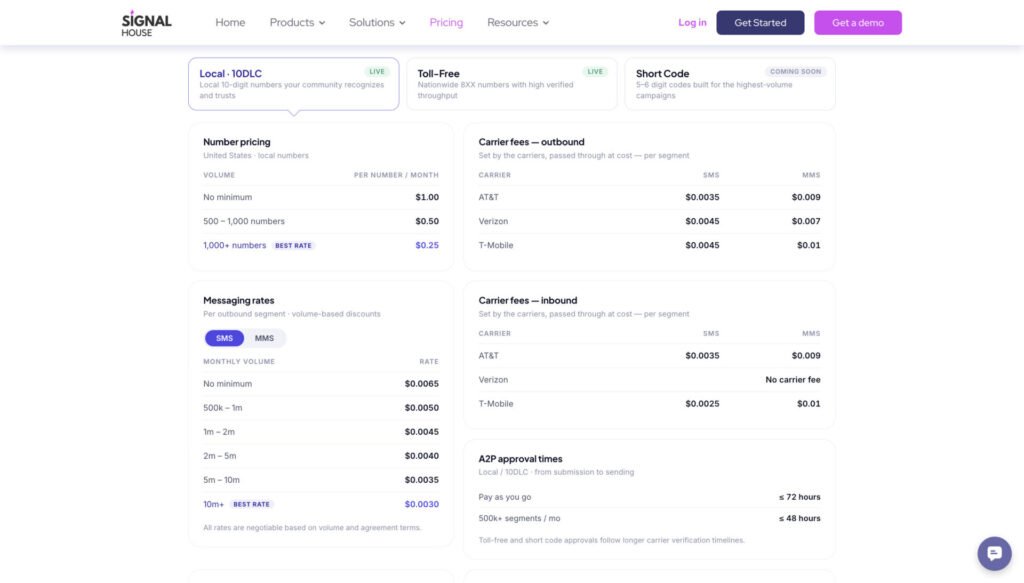
Verdict: Best overall alternative for organizations where SMS is a business workflow, not merely another API endpoint.
2. Telnyx - Best Twilio Alternative for Developers and Telecom Control
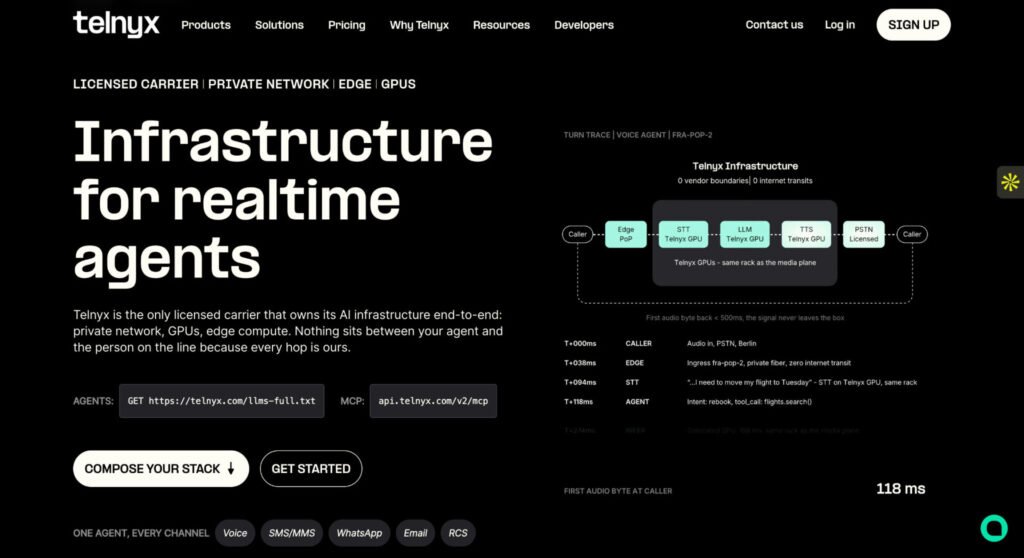
Best for: Engineering teams that want programmable messaging with greater control over the underlying communications infrastructure.
Telnyx is probably the most technically interesting Twilio alternative on this list.
Its positioning is infrastructure-heavy: APIs sit on top of a communications network that gives technical teams significant control over messaging and telecom functionality.
For developers, that's attractive.
Telnyx currently lists outbound U.S. SMS at $0.004 per message part plus carrier fees under its pay-as-you-go model.
That compares with Twilio's currently published U.S. long-code SMS base rate of $0.0083 per outbound message, again before applicable carrier fees.
But price alone isn't the reason to choose Telnyx.
Its real advantage is control.
Telnyx strengths
- Strong developer APIs
- Programmable telecom infrastructure
- Competitive base SMS pricing
- SMS and MMS
- Voice capabilities
- Volume-based pricing
- Suitable for sophisticated communications architectures
Telnyx trade-offs
That control comes with responsibility.
If you want business users to manage messaging campaigns, CRM workflows and operational changes independently, you'll likely need to build more of that layer yourself.
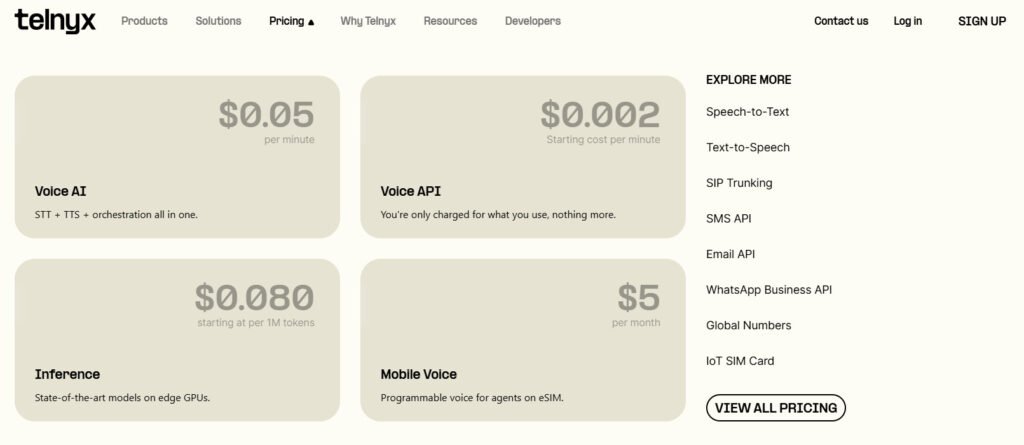
Verdict: Telnyx is one of the strongest Twilio alternatives for engineering-led organizations. Signal House is the stronger fit when the objective is reducing operational and engineering overhead around business SMS.
3. Plivo - Best Cost-Focused Twilio
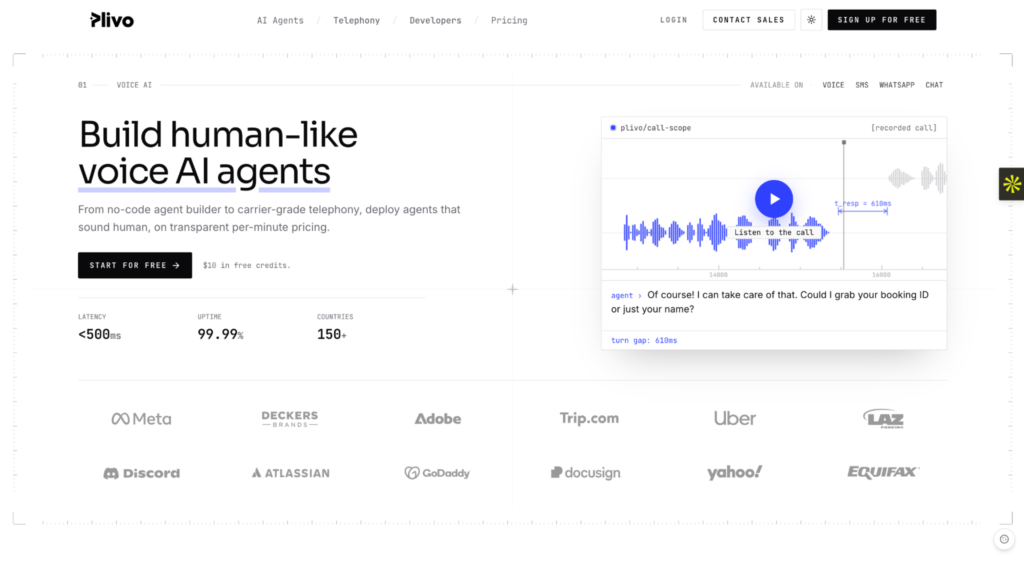
Best for: Developers who primarily need programmable SMS and care heavily about API economics.
Plivo is closer to the traditional Twilio API model.
You integrate its messaging APIs into your application, configure your numbers and messaging logic, and retain significant control over the application layer.
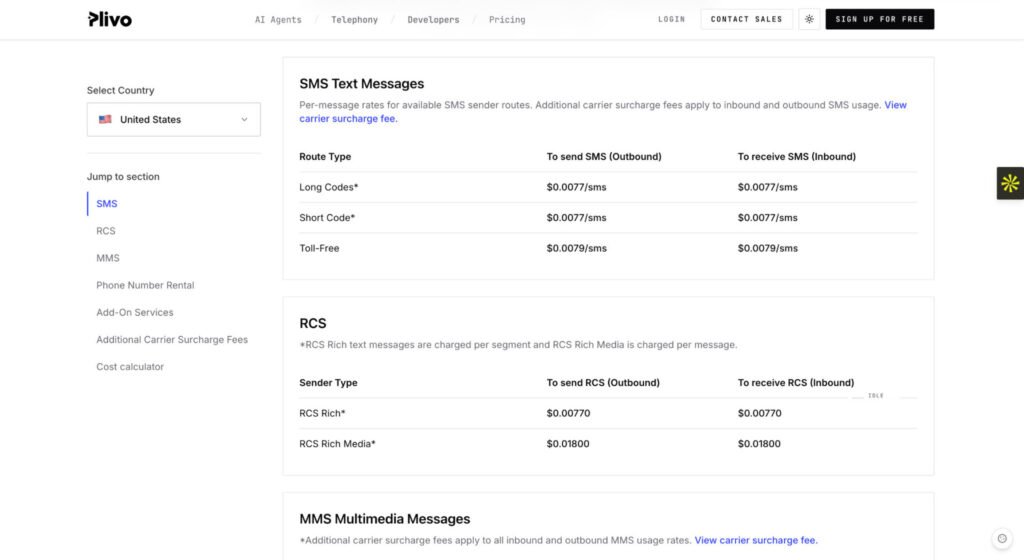
Plivo currently publishes U.S. long-code SMS pricing of $0.0077 per outbound or inbound SMS, with additional carrier surcharge fees.
The difference from Twilio's $0.0083 base rate appears relatively small at the individual-message level.
At significant volume, however, fractions of a cent become meaningful.
Plivo strengths
- Mature SMS API
- Competitive pricing
- Straightforward developer model
- SMS and RCS support
- Voice products
- Pay-as-you-go structure
Plivo trade-offs
Plivo remains developer-centric.
If your challenge is not "How do we send an SMS programmatically?" but rather "How do our sales and marketing teams operate SMS efficiently inside our existing workflow?", you'll need to evaluate the additional application layer.
Verdict: A strong alternative for developers optimizing programmable messaging cost, but less differentiated for organizations primarily trying to reduce messaging operational complexity.
4. Bandwidth - Best for Enterprise Communications Infrastructure
Best for: Large organizations that want carrier-grade infrastructure and have engineering resources to manage it.
Bandwidth operates deeper in the communications stack than many software-first messaging providers.
That matters for enterprises where communications infrastructure itself is strategically important.
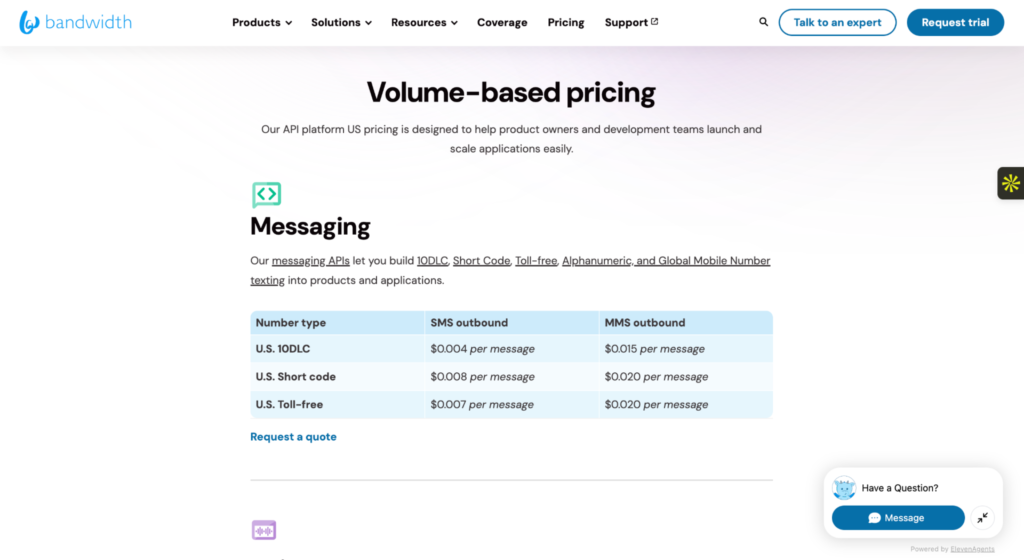
Its APIs support messaging and voice, while its network infrastructure makes it attractive for large-scale communications deployments.
Bandwidth strengths
- Communications network infrastructure
- Enterprise-grade positioning
- Messaging APIs
- Voice APIs
- Strong fit for high-volume deployments
Bandwidth trade-offs
Bandwidth is infrastructure-oriented.
That's an advantage for telecom-heavy engineering teams and potentially unnecessary complexity for an organization that simply wants sales representatives sending compliant SMS from a CRM.
Verdict: Excellent enterprise infrastructure; less compelling for teams prioritizing fast, simple business messaging deployment.
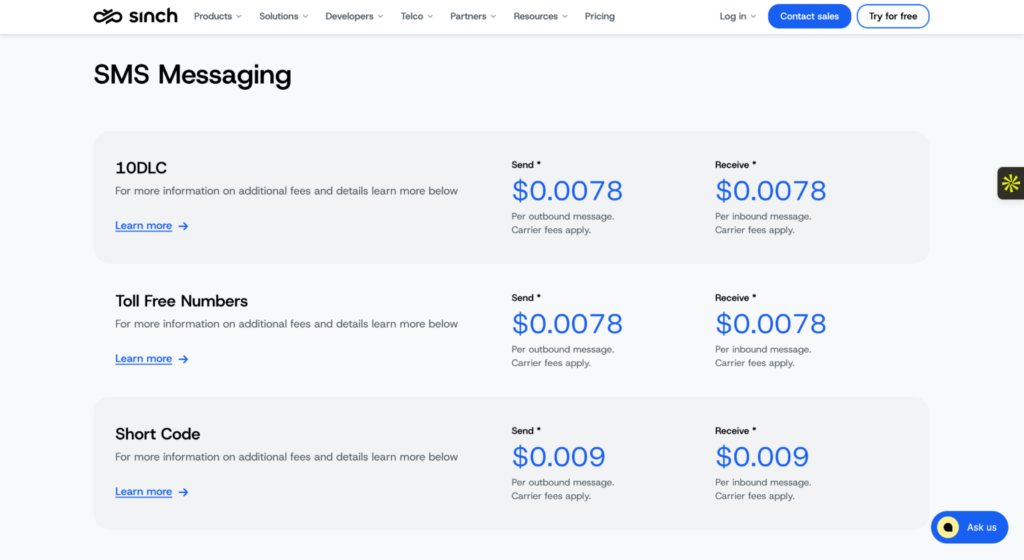
5. Sinch - Best for Global Omnichannel Messaging
Best for: Large international organizations communicating across SMS, WhatsApp, RCS, email and voice.
Sinch becomes much more compelling once the problem expands beyond SMS.
For a multinational enterprise, customer communication rarely exists on one channel.
A user might receive an authentication message through SMS, a promotional interaction through RCS, customer support through WhatsApp and transactional communication through email.
Sinch is designed for that type of environment.
Sinch strengths
- Global communications footprint
- SMS
- RCS
- Voice
- Enterprise-scale customer engagement
Sinch trade-offs
Breadth creates complexity.
If 90% of your requirement is U.S. A2P SMS connected to a CRM, adopting a large omnichannel platform may be unnecessary.
Verdict: One of the strongest alternatives for multinational omnichannel deployments; overbuilt for many SMS-first organizations.
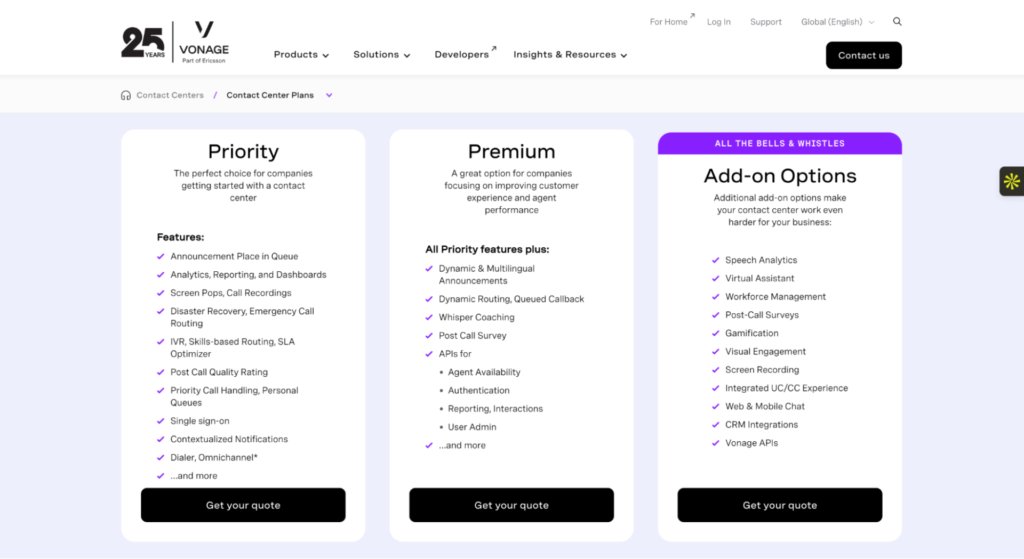
6. Vonage - Best Broad CPaaS Alternative
Best for: Organizations looking for another established communications API ecosystem rather than an SMS-specific replacement.
Vonage competes with Twilio across a broad CPaaS surface.
Messaging, voice, video and verification capabilities make it particularly relevant for organizations that need multiple communications functions from one provider - including teams that also need a VoIP / business phone layer alongside programmable messaging.
Vonage strengths
- Mature communications platform
- SMS APIs
- Voice
- Video
- Verification
- International capabilities
Vonage trade-offs
If the primary problem you're solving is A2P business SMS, the breadth of a CPaaS platform doesn't necessarily simplify your stack.
Verdict: A legitimate broad Twilio competitor, particularly when your requirements extend well beyond SMS.
7. Infobip - Best for Enterprise Omnichannel Customer Engagement
Best for: Enterprises operating complex international customer journeys.
Infobip sits closer to Sinch than to a lightweight SMS API provider.
Its value increases as communication requirements become more geographically distributed and channel-diverse.
If you're coordinating customer interactions across SMS, messaging applications, email and other channels, its broader engagement architecture becomes useful.
Strengths
- International messaging
- Enterprise infrastructure
- Omnichannel capabilities
- Customer engagement tooling
- Suitable for sophisticated global deployments
Trade-offs
It may be considerably more platform than an SMS-first startup or CRM-driven sales organization needs.
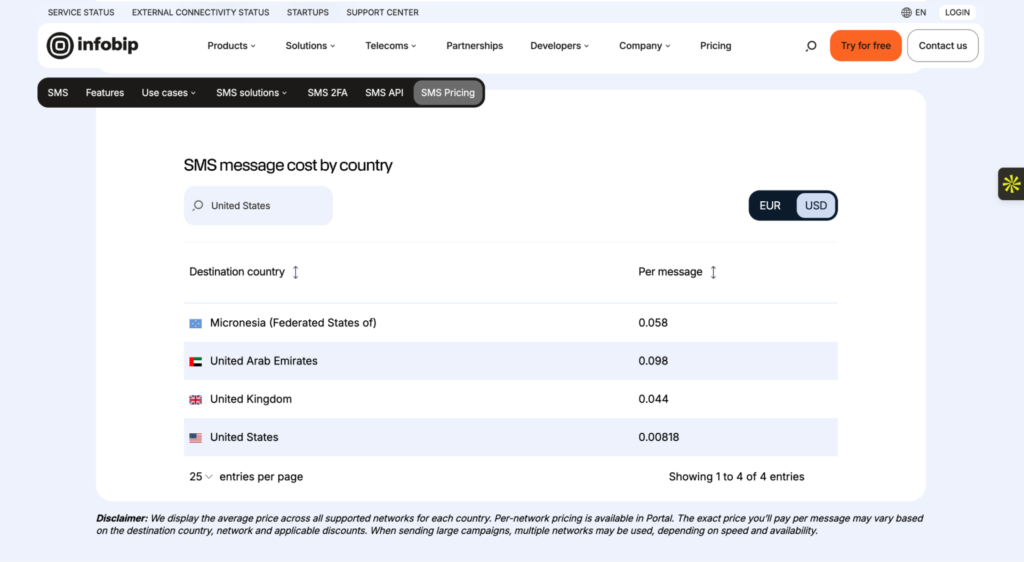
Verdict: Strong for complex enterprise communication programs; less compelling when simplicity is the primary requirement.
8. Amazon SNS - Best for AWS-Native Transactional SMS
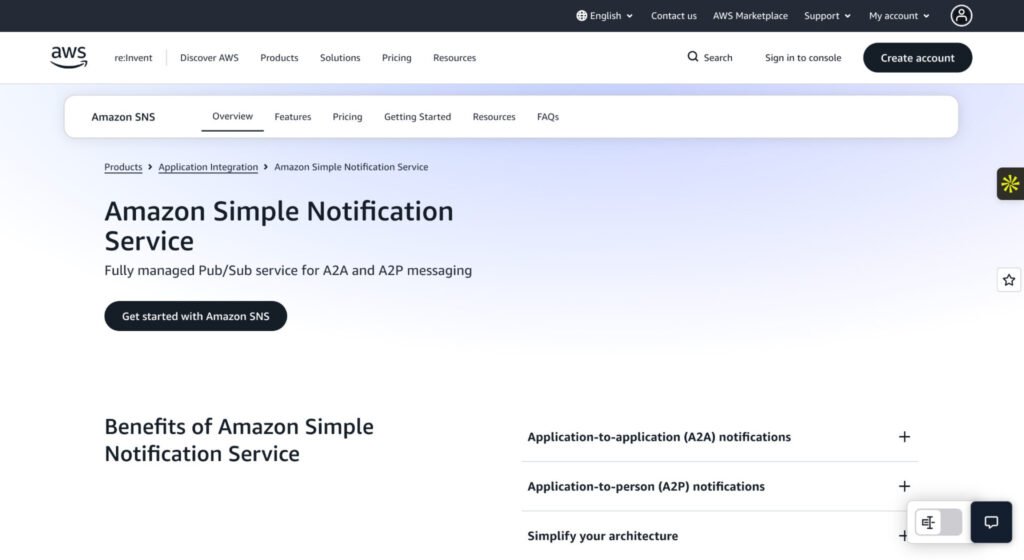
Best for: Engineering teams whose messaging requirement is primarily transactional and whose infrastructure already lives in AWS.
Amazon Simple Notification Service solves a different problem.
It's particularly useful when an AWS application needs to trigger SMS notifications without introducing an entirely separate communications architecture.
For example:
Application event → SNS topic/API → SMS delivery
That's elegant for transactional workloads.
It becomes less elegant when you need CRM conversations, sales messaging, campaign management and rich business messaging workflows.
Amazon SNS strengths
- Native AWS integration
- Scalable infrastructure
- Transactional messaging
- Usage-based model
- Familiar environment for AWS developers
Amazon SNS trade-offs
- Not a full CPaaS replacement
- Limited business messaging workflow
- Not CRM-first
- Requires AWS expertise
- Additional tooling may be needed for sophisticated campaigns
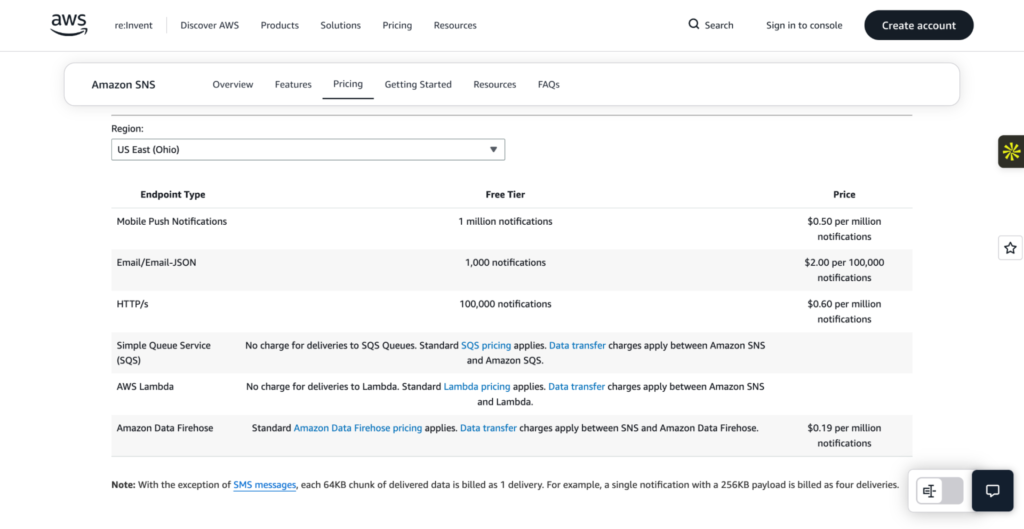
Verdict: Excellent infrastructure component for AWS applications; not a direct replacement for a business messaging platform.
Best Twilio Chat Alternative: What About Two-Way, App-Based Conversations?
Not every "Twilio alternative" search is about SMS.
Twilio also sells a Conversations/Chat API for embedding real-time, two-way messaging inside apps and websites - separate from A2P SMS. If what you actually need is a twilio chat alternative for in-app or on-site live chat rather than carrier-routed text messages, the evaluation criteria change:
- SDKs for web, iOS and Android
- Presence, typing indicators and read receipts
- Moderation and message history
- Integration with your support desk or CRM
Tools purpose-built for embedded conversations - such as CometChat, listed in our in-app chat deals category - are usually a better architectural fit for this use case than repurposing an SMS-first API. If chat is meant to support a broader customer engagement or support motion, it's worth browsing our AI chatbot tools and the best AI chatbot tools guide as well, since several of those platforms now combine automated and human-assisted chat.
Twilio Alternatives for Customer Data Platforms (CDP) in Germany & the EU
A recurring, more specialized question is what the best twilio alternatives for a customer data platform in Germany look like. This isn't quite the same evaluation as picking an SMS API - a customer data platform (CDP) unifies customer profiles across channels, and messaging is just one channel it triggers.
Twilio owns Segment, one of the best-known CDPs, and can pair it with Twilio's own messaging APIs. For German and broader EU businesses evaluating alternatives, the practical questions to ask any CDP-plus-messaging vendor (Twilio/Segment included) are:
- Where is customer data hosted, and does that satisfy GDPR data-residency expectations?
- Does the vendor support EU carrier routing for SMS and WhatsApp, not just U.S. A2P 10DLC?
- Can the CDP export events into whichever messaging API or CRM you ultimately choose, rather than locking you into one messaging provider?
- Does consent and opt-out handling map to both TCPA-style U.S. rules and the EU's ePrivacy/GDPR consent requirements?
In practice, most German and EU teams end up running a best-of-breed CDP alongside a dedicated messaging/A2P provider (Signal House, Telnyx, Sinch or Infobip, depending on scale and channel mix) rather than expecting a single vendor to be the best answer for both jobs at once.
Signal House vs Twilio vs Telnyx vs Plivo
For SMS-first organizations, these are arguably the four most interesting platforms to compare directly.
| Capability | Signal House | Twilio | Telnyx | Plivo |
|---|---|---|---|---|
| Programmable SMS | Yes | Yes | Yes | Yes |
| MMS | Yes | Yes | Yes | Yes |
| A2P focus | High | High | High | High |
| CRM-oriented workflows | Strong | Build/integrate | Build/integrate | Build/integrate |
| No/low-code operations | Strong | Available across products | Limited relative to business platforms | API-oriented |
| Developer control | Very Strong | Very strong | Very strong | Very strong |
| Telecom-level control | Moderate to Strong | Strong | Very strong | Strong |
| Best fit | Business messaging | Broad CPaaS | Telecom/API infrastructure | Cost-focused API |
This table reveals the actual decision.
Signal House doesn't need to beat Telnyx on low-level network programmability or Twilio on total API breadth to be the better choice for many organizations. Its advantage is reducing the distance between telecom infrastructure and the people who actually need to use SMS.
How to Compare Twilio Alternatives Properly
A proper SMS provider evaluation should go beyond feature matrices.
Here are the technical and operational questions worth asking.
1. What is the effective cost per delivered message?
Don't compare only API rates.
Model:
Base SMS rate + carrier surcharge + number cost + registration fees + segmentation + support + infrastructure + engineering
Then calculate cost against your actual monthly traffic.
2. What happens when messages fail?
Look at delivery receipts, error codes, retry behavior, queueing and routing.
Your application should be able to distinguish between temporary failures, carrier rejection, invalid destinations and compliance-related blocking.
3. How does the platform handle inbound messaging?
Outbound pricing receives most of the attention, but two-way messaging introduces additional requirements:
- Inbound webhooks
- Conversation state
- Contact mapping
- STOP/HELP handling
- CRM synchronization
- Number assignment
- Message history
4. How difficult is A2P registration?
Evaluate how much assistance the provider gives you with brand registration, campaign registration and troubleshooting rejected campaigns.
The operational difference between platforms can matter more than a tiny difference in API price.
5. What is your engineering dependency?
Ask how many routine messaging operations require a developer.
That includes:
- Creating campaigns
- Changing templates
- Adding users
- Managing contacts
- Reviewing replies
- Updating CRM automation
- Monitoring delivery
- Managing opt-outs
Every recurring engineering task contributes to TCO.
6. What channels will you actually use?
Don't buy an omnichannel architecture because the feature matrix looks impressive.
If your workload is overwhelmingly SMS, optimize for SMS.
If you're genuinely moving toward WhatsApp, RCS, voice and conversational messaging across countries, then a broader CPaaS such as Sinch, Infobip, Vonage or Twilio becomes more logical. If voice is part of that mix, compare dedicated business phone and business phone systems options - such as KrispCall and CallHippo 0 alongside your messaging API decision, since bundling everything into one CPaaS isn't always the cheapest path.
When Twilio Is Still the Better Choice
Twilio remains an excellent platform for the right organization.
You should seriously consider staying with Twilio if:
- Your communications architecture is already deeply integrated with its APIs
- You have dedicated communications engineers
- You use several Twilio products
- You need extensive API flexibility
- You have complex or unusual communications requirements
- Migration cost exceeds realistic savings
- Your existing deliverability and support are satisfactory
- Switching providers simply because another company advertises a lower SMS rate is poor infrastructure planning.
- Migration should solve a measurable problem.
- That problem might be cost.
- It might be engineering overhead.
- It might be CRM integration.
- It might be A2P operations.
- Or it might be support.
- Define that problem before choosing the replacement.
Which Twilio Alternative Should You Choose?
The easiest way to decide is to work backward from your architecture.
Choose Signal House if:
Your priority is A2P business SMS, CRM integration, operational simplicity and reducing how much engineering work is required to run messaging.
Choose Telnyx if:
You have a strong engineering team and want greater control over programmable telecom infrastructure.
Choose Plivo if:
You primarily need an SMS API and are heavily focused on messaging economics.
Choose Bandwidth if:
You're an enterprise building communications deeply into your infrastructure.
Choose Sinch or Infobip if:
You're running international, omnichannel customer engagement at scale.
Choose Vonage if:
You want an established broad CPaaS covering several communication APIs.
Choose Amazon SNS if:
SMS is primarily a transactional notification layer inside an AWS architecture.
Stay with Twilio if:
Your current implementation works, your team benefits from its broad API ecosystem and switching doesn't solve a meaningful operational or financial problem.
Final Verdict: What Is the Best Twilio Alternative in 2026?
For most businesses evaluating Twilio alternatives specifically for SMS, we would put Signal House at the top of the shortlist.
Not because it has the largest communications ecosystem - it doesn't.
And not because every technical team needs the same architecture - they don't.
Its advantage is more practical.
Signal House combines programmable messaging with the operational components businesses typically have to assemble around an SMS API: A2P messaging, CRM connectivity, campaign workflows and tooling that can be used beyond the engineering team.
That makes it particularly compelling for SaaS companies, agencies, sales organizations and marketing teams where SMS needs to operate as a business channel rather than an isolated developer service.
For infrastructure-heavy development teams, Telnyx is arguably the more technically interesting alternative.
For cost-focused API deployments, Plivo deserves consideration.
For enterprise omnichannel requirements, Sinch and Infobip are stronger candidates.
And Twilio itself remains one of the strongest options when API breadth and developer flexibility outweigh the benefits of specialization.
The right decision ultimately comes down to five things:
Cost. Control. Compliance. Complexity. Support.
Compare those against your actual messaging architecture - not the size of each provider's feature list - and the best Twilio alternative usually becomes much easier to identify.
Frequently Asked Questions
What is the best Twilio alternative in 2026?
Signal House is one of the strongest overall Twilio alternatives for businesses primarily using Twilio for A2P SMS, CRM messaging and business texting. Telnyx is particularly strong for developer-controlled communications infrastructure, while Sinch and Infobip are better suited to large omnichannel deployments.
What is the best alternative to Twilio for SMS?
For business SMS and CRM-integrated messaging, Signal House is a strong option and arguably the best alternative to Twilio for SMS. For highly programmable SMS infrastructure, Telnyx and Plivo are two of the strongest alternatives to evaluate.
What are the best SMS API alternatives to Twilio?
Signal House, Telnyx and Plivo are consistently the strongest SMS API alternatives to Twilio in 2026 - this exact query is sometimes typed with unrelated brand names attached (for example, "twilio vs mobilo") by teams comparing lightweight mobile messaging SDKs against full A2P platforms, but the evaluation criteria (A2P compliance, CRM integration, pricing) stay the same regardless of which mobile app or SDK you're currently using.
Is Signal House better than Twilio?
Yes. Signal House can be a better fit for businesses focused primarily on A2P SMS, CRM integrations and reducing messaging operational complexity.
Is there a free Twilio alternative?
Most production SMS platforms aren't truly free because carrier delivery has an underlying cost, so a true twilio free alternative for production traffic doesn't really exist.
Free trials and testing credits are common across Signal House, Telnyx, Plivo and others, but production workloads should be evaluated based on their actual per-message and infrastructure costs.
Is there a cheaper alternative to Twilio?
Yes. Some providers publish lower base SMS API rates - Telnyx and Plivo both currently price below Twilio's published U.S. long-code rate. However, compare carrier surcharges, sender fees, registration, message segmentation, volume discounts, support and engineering costs before concluding that one provider is cheaper overall.
What is the best Twilio alternative for CRM SMS integration?
Signal House is particularly relevant for teams searching for the best twilio alternatives for CRM SMS integration or for CRMs looking to integrate SMS, because its messaging platform is designed around API and CRM-connected business messaging rather than requiring every workflow to be constructed exclusively at the API layer.
What is the best Twilio alternative for developers?
Telnyx is one of the strongest options for developers who want extensive programmable communications and greater telecom infrastructure control. Plivo is another strong choice for developers prioritizing straightforward SMS APIs and cost.
Can I migrate from Twilio without downtime?
A carefully planned migration can minimize disruption. A typical process involves configuring the new provider, completing required A2P registration, porting or provisioning numbers where necessary, rebuilding integrations, testing webhooks and delivery receipts, running both environments in parallel, and then shifting production traffic.